
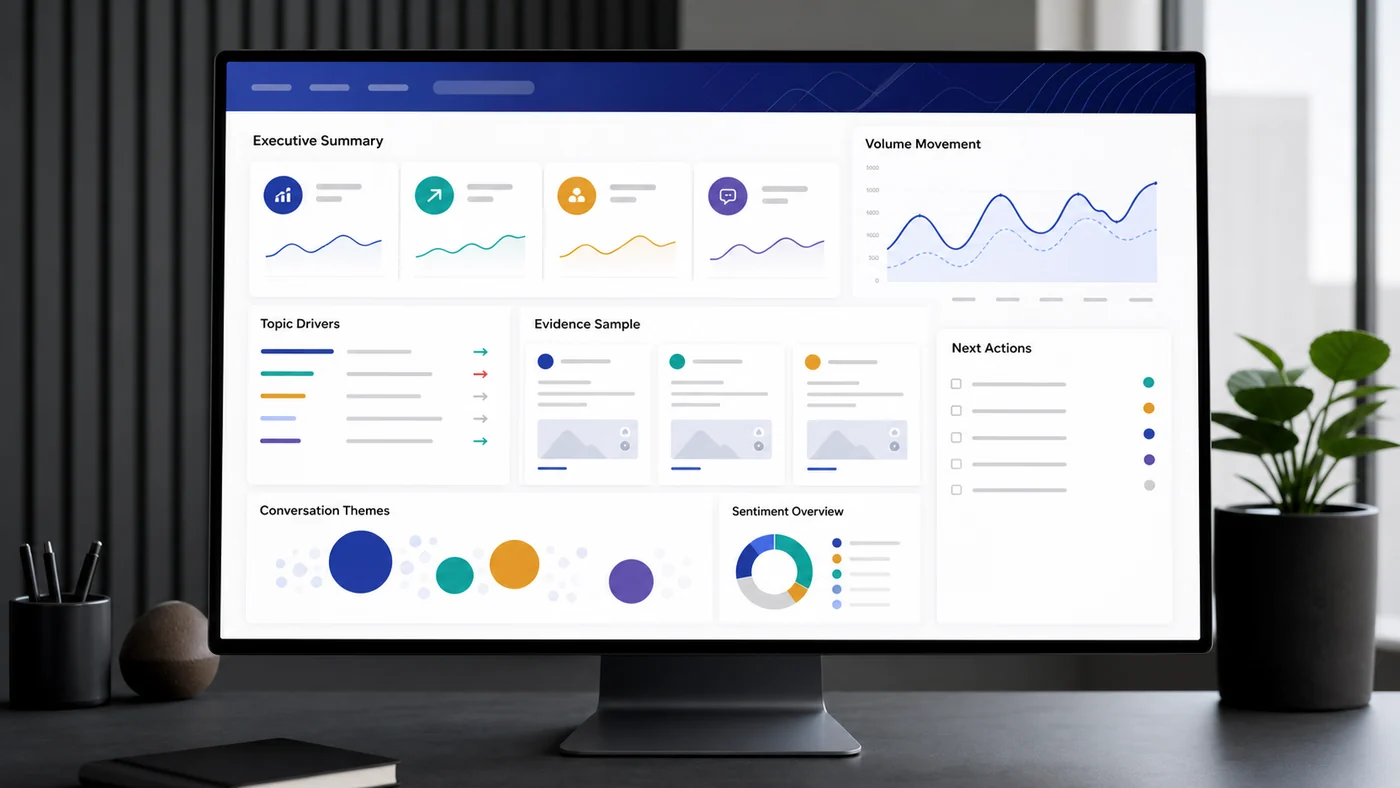
Executives do not need a dashboard dump
A weekly report should answer four questions: did public discussion change, why did it change, is there a risk or opportunity, and what should the team do next?
If the report does not answer those questions, it is only a data export.
One-page summary
| Section | What to write |
|---|---|
| One-line judgment | Growth, stable, volatile, or risk state |
| Key changes | Three numbers that matter |
| Main driver | Platform, topic, campaign, competitor, or event |
| Watch item | The most important risk or opportunity |
| Next action | Who should do what next week |
The first page should be readable without opening the dashboard.
Body structure
Start with the conclusion, not the count. Then explain volume changes, sentiment and topic drivers, competitor context, representative public mentions, and next actions.
A useful sentence sounds like this:
Public discussion increased this week, mainly from Xiaohongshu experience posts and Douyin comments. Negative share did not rise with volume, so the movement looks more like content spread than risk escalation.
That is more useful than “1,842 mentions were collected.”
Evidence samples
Choose five to ten samples that explain the trend: high-engagement positive mentions, high-engagement negative mentions, common questions, competitor comparisons, and platform-specific examples. Each sample should link back to the public source.
Escalation rules
Escalate when negative volume rises for several days, influential accounts join, the same issue appears across platforms, media or search results pick it up, or the topic involves safety, legal, minors, medical, or financial sensitivity.
Searchore reports should keep the evidence chain intact: trend, sample, source, and action.
Use the editable brand intelligence report template with the brand monitoring ROI and KPI framework and the public-data methodology.
Want to see this with your own brand data?
Book a Searchore demo and we will walk through platform coverage, refresh cadence, reports, and keyword setup for your brand and competitors.
Searchore supports monitoring legally accessible public content. Coverage may vary depending on platform rules, public availability, authorization methods, and lawful data sources. Platform names are used only to describe public sources that may be monitored and do not imply official partnership, authorization, or endorsement unless explicitly stated.