
Do not start with “how many platforms”
Platform count is easy to sell and hard to evaluate. A better question is whether the tool covers the public sources you actually need, whether every insight can be traced back to evidence, and whether the output helps your team make decisions.
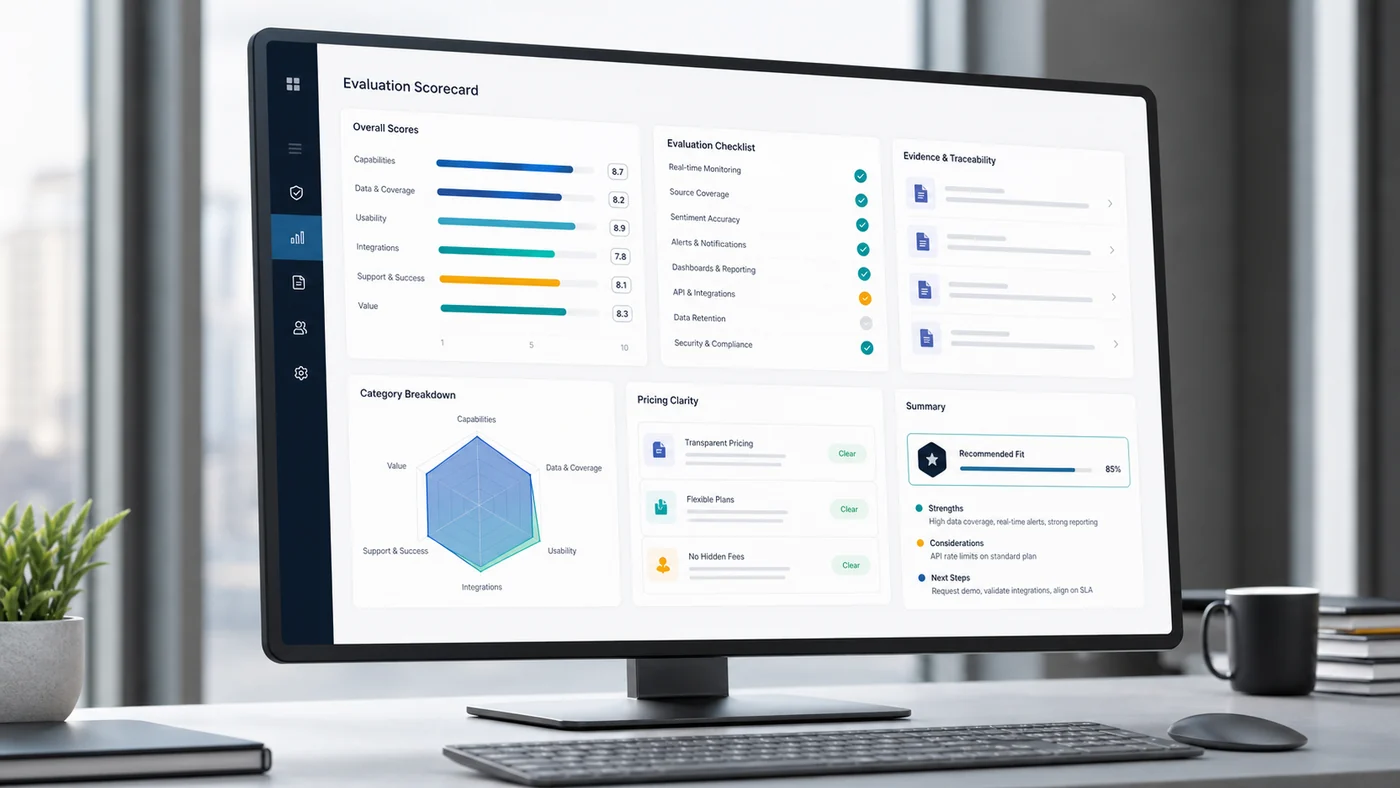
Buyer scorecard
| Dimension | Weight | What to check |
|---|---|---|
| Public source coverage | 20 | News, social, video, forums, reviews, search, and market-specific sources |
| Evidence traceability | 15 | Can charts, sentiment, topics, and alerts link back to public mentions? |
| Keyword setup | 15 | Aliases, exclusions, competitors, products, campaigns, and languages |
| Analytics usefulness | 15 | Sentiment, topics, competitors, and SOV that lead to action |
| Reporting | 15 | Weekly reports, campaign recaps, executive summaries, risk briefs |
| Alerts and workflow | 10 | Rules, notifications, permissions, review, and assignment |
| Pricing clarity | 10 | Clear drivers: keywords, volume, sources, refresh rate, comment depth, service level |
Under 60 points, the tool is usually basic monitoring. From 60 to 80, it may support daily brand work. Above 80, it can support PR, agencies, multi-brand teams, and mixed China/global monitoring.
Questions to ask vendors
Ask where coverage comes from, whether the system only uses legally accessible public content, how aliases and exclusions work, whether negative sentiment links to source posts, whether topics can match your business taxonomy, how competitor comparison works, whether comments are separated from root posts, how alerts are configured, and what a real executive-ready report looks like.
Also ask why the price is what it is. Monitoring Xiaohongshu, Douyin, comments, historical data, near-real-time refresh, and custom reporting may carry very different costs. A serious vendor should explain those tradeoffs.
Red flags
Be careful when a vendor says it can scrape everything, sentiment is always accurate, every source is real time, original evidence cannot be shown, or pricing has nothing to do with volume, sources, or refresh frequency.
The minimum trial
Run a seven-day trial with your own brand, two or three competitors, product terms, exclusions, priority sources, and one sample report. At the end, ask whether the tool reduced manual searching, screenshot collection, spreadsheet work, and explanation time.
If it did not, the feature list does not matter.
Want to see this with your own brand data?
Book a Searchore demo and we will walk through platform coverage, refresh cadence, reports, and keyword setup for your brand and competitors.
Searchore supports monitoring legally accessible public content. Coverage may vary depending on platform rules, public availability, authorization methods, and lawful data sources. Platform names are used only to describe public sources that may be monitored and do not imply official partnership, authorization, or endorsement unless explicitly stated.